Auburn’s Mass Timber Research Grows with New Architecture Master’s Degree
The School of Architecture, Planning and Landscape Architecture (APLA) is expanding its leadership in sustainable building innovation with a new Architecture master's focused on mass timber design.
The program is designed to prepare students for careers at the forefront of one of the architecture, engineering and construction industry’s fastest-growing sectors.
Auburn’s newest graduate program is tapping into Alabama’s status as the third largest timber industry in the United States and the largest in the Southeast. The research takes both a local, personal perspective—exploring how investment in the timber industry can provide economic development to foresters in the state—and a 50,000-foot-high perspective—studying mass timber in order to make strides in global carbon reduction.
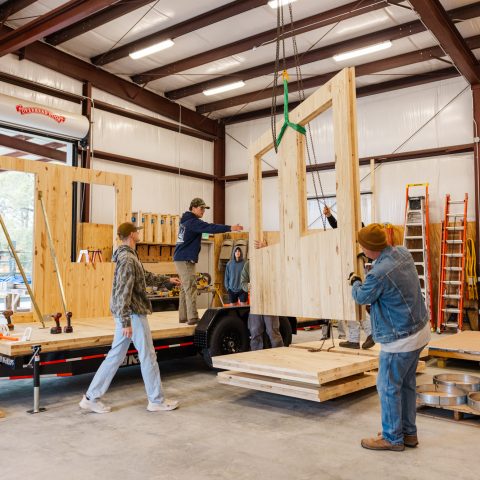
Launched this summer, the three-semester program offers students two distinct pathways after graduation: professional practice with leading mass timber firms or continued academic research and teaching. In 12-credit hour semesters, students will study material fabrication and assembly in the College of Architecture, Design and Construction (CADC) Research Shop, explore forest ecology and sustainable management practices in the field and develop research-driven design solutions through a capstone experience.
Through a built-in, sponsored externship in the final semester, students will gain firsthand experience working with nationally recognized firms such as Leers Weinzapfel Architecture (LWA) in Boston and Skidmore, Owings & Merrill (SOM) in Chicago. These week-long immersive experiences will expose students to emerging research and professional approaches while helping shape their capstone projects.
“We wanted to create a program that supports both professional and academic trajectories,” said Architecture Graduate Program Chair David Shanks. “The externships are a key part of helping students understand where the field is headed and how they can contribute.”
Modeled in part after programs found in other areas of North America with strong forest-based economies, Auburn’s program distinguishes itself through its integration of professional externships and research opportunities. Students will participate in faculty-led research projects—like Shanks’ work with HudsonAlpha Institute for Biotechnology creating a mobile, bio-based pavilion—and may receive funding through externally sponsored grants, gaining valuable experience while contributing to advancements in mass timber technology.
The program launched this summer with a cohort of two students, both of whom are serving as graduate teaching assistants for technology-based and studio courses, as well as graduate research assistants on extramurally funded grants. The students’ work is compensated through a stipend and tuition waiver, helping to make graduate studies more accessible and affordable. The program has the capacity to include 8-12 students and will begin recruiting its first full cohort this Fall.
Different courses and design projects—such as urban housing or manufacturing facilities—will draw on the varied expertise of the Auburn Mass Timber Collaborative (AMTC), a group of Auburn faculty drawn from the CADC, the Samuel Ginn College of Engineering and the College of Forestry, Wildlife and Environment, whose research, education and outreach pursuits aim to grow more resilient communities.
Led by Shanks with Architecture Professors of Practice Tom Chung and Kiel Moe, the interdisciplinary instructional team includes Landscape Architecture Graduate Chair and Associate Professor Emily Knox; Gottleib Associate Professor David Roueche from the Samuel Ginn College of Engineering; Associate Professor Yucheng Peng from the College of Forestry, Wildlife and Environment; and Assistant Research Professor Jake Elbrecht from the McWhorter School of Building Science.
“Mass timber design is, by definition, integrative. It doesn’t naturally lend itself to the conventional separation of disciplines where an architect designs a building and hands it over to the contractor who coordinates with the fabricator,” Shanks explained. “Auburn’s degree program mirrors the interdisciplinary nature of the industry.”
In addition to the collaboration between architects, builders and engineers, the program weaves in conversations with forestry experts in order to maintain the research’s resilience parameters.
“Working with an interdisciplinary team that includes Auburn’s Samuel Ginn College of Engineering and College of Forestry, Wildlife and Environment gives us a broader understanding of mass timber design, from its technical potential to its ecological impact,” Shanks said.
The program relies on the world-renowned expertise of its faculty members, helping to establish Auburn University as a southeast hub for mass timber research and education.
“Together with the AMTC, we hope that this program continues to cultivate and grow our reputation as a center for mass timber,” Shanks said.
See more in:
Auburn Mass Timber Collaborative (AMTC),
Faculty Collaboration,
Faculty Recognition,
Mass Timber,
Research,
Student Experience
Related people:
David Shanks,
Emily Knox,
Kiel Moe,
Jake Elbrecht,
Tom S. Chung