Auburn Faculty Advance New State Wildlife Action Plan
Only once every 10 years does a single document bring together so many professionals devoted to managing the diversity of wildlife throughout the state.
By the end of 2025, the Alabama Department of Conservation & Natural Resources (ADCNR) will finalize an updated version of its State Wildlife Action Plan (SWAP), a blueprint for preventing species from becoming endangered. Auburn University’s Kelly Homan (College of Architecture, Design and Construction) and Katelyn Lawson (College of Agriculture) partnered to receive over $400,000 from the ADCNR to help lead the SWAP revision, due to their respective expertise in landscape-scale conservation design and conservation of native species.
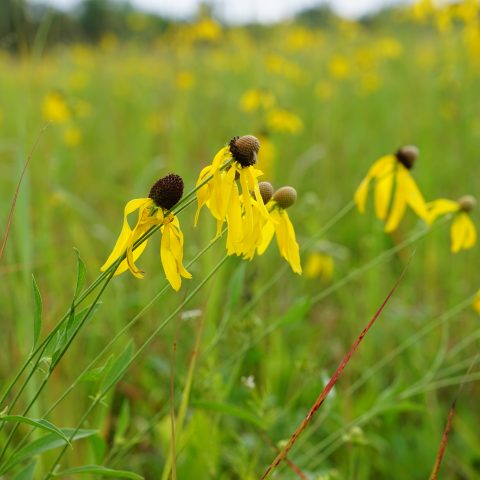
This revision marks the first time the SWAP was expanded to address imperiled plants, which is critical given their widespread importance to landscape-level biodiversity and wildlife management.
“Including plants in State Wildlife Action Plans underscores that, like animals, they are fundamental to ecological health across states. Historically underrepresented in both funding and research, plants’ inclusion in the Alabama 2025 SWAP revision marks a significant step toward enhancing their role in conservation planning and action,” explained Homan.
Homan and Lawson’s contributions focused on identifying Conservation Priority Areas (CPAs), which are locations crucial for protecting biodiversity, and mapping a network of statewide wildlife corridors, or strips of natural landscape connecting fragmented habitats. With the help of Research Assistant Jordan Bralley (College of Agriculture), the team helped remodel CPAs to include under-studied regions like the Black Belt. Teams of experts were convened to review the data related to every taxonomic group and to evaluate the draft CPAs and corridors. Maps of CPAs and wildlife corridors were then created for each evaluated taxonomic group and for the overall state to guide conservation partners in prioritizing activities that benefit species of greatest need.
SWAPs are mandated for states to receive federal funding for wildlife conservation. This phase of work was funded by ADCNR through the U.S. Fish and Wildlife Service. There is also hope that pending legislation known as Recovering America’s Wildlife Act will be enacted, which would provide states with $1.4 billion to implement their SWAP. Once the SWAP is finalized, Auburn research teams will be well-poised to leverage such funding opportunities to address the most crucial conservation areas.
This project was funded by the Alabama Department of Conservation and Natural Resources through a U.S. Fish and Wildlife Service Grant.
See more in:
Community Engagement,
Faculty Collaboration,
Faculty Recognition,
Faculty Work,
Outreach,
Research
Related people:
Kelly Homan