Architecture, History Faculty Awarded Auburn Creed Grant for Historic Preservation Pilot

Two Auburn University faculty members are testing Alabama’s first Historic Preservation academic program to research disappearing Rosenwald Schools.
Gorham Bird, Assistant Professor of Architecture in the College of Architecture, Design and Construction (CADC), and Elijah Gaddis, Hollifield Associate Professor of Southern History and the co-director of the Public History Program in the College of Liberal Arts (CLA), are collaborating on interdisciplinary research with funds from the Auburn Alumni Association’s newly established Creed Grant. The Creed Grant program was created to support projects that exemplify the Auburn Creed and further the mission of the university.
The Rosenwald Schools, constructed from 1917 to 1932, were intended to educate Black children in the racially segregated South. Sponsored by Julius Rosenwald, president of Sears and Roebuck, Co. and originated by Tuskegee Institute’s Booker T. Washington, 5,000 Rosenwald Schools spread across the south, with over 400 in Alabama. Today, some schools have been repurposed into community centers, museums and church facilities, but many are lost to history.
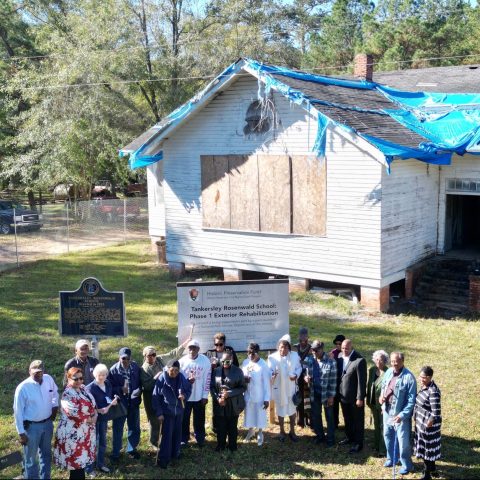
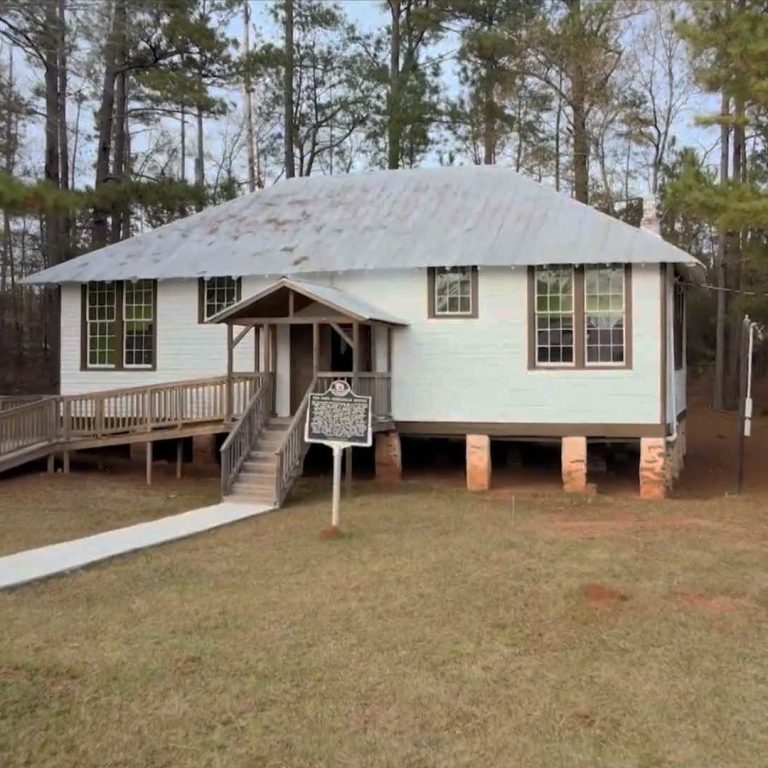
Over a five-year collaboration, faculty in CADC and CLA have been working to identify, document and preserve the remaining Rosenwald Schools in Alabama, including the Boyd family’s Tankersley Rosenwald School. The team has received multiple rounds of funding through an Auburn University Creative Work and Social Impact Scholarship grant, CADC grants, Tiger Giving Day and the National Park Service. The latest grant—totaling $20,000—will support the pilot phase for a new Historic Preservation academic program, the first in Alabama, known as “Buildings as a Bridge: Connecting Students, Alumni & Practitioners through Historic Preservation.”
“The Creed Grant funds allow us to better engage our students with unique, field-based learning experiences,” Gaddis said. “Working through our research projects, students work directly with rural community organizations in historic preservation projects.”
Bird noted that the setting of off-campus courses—that will be shared between the Architecture and History programs—and the corresponding project focuses on both space and place.
“It allows students to both see and feel the power of historic spaces but also hear firsthand the meaning of historic places through collecting oral histories of community members,” he said.
“At its core, that is what preservation is,” Bird explained. “Finding ways to connect to a tangible past, through place and people. In that process, students will be exposed to historical research, site documentation, interpretation, theory and preservation practice.”
The one-year project runs through the summer of 2026 with planning, recruitment, community outreach, fieldwork and reporting phases. The team is working with the Auburn Black Alumni Council to identify alumni who attended the Rosenwald Schools and will partner with the Midway community at the Merritt Rosenwald School to record oral histories. In addition to creating a digital record of the social history, the team will conduct a Historic American Building Survey of a Rosenwald School that will be submitted to the Library of Congress.
“We like to say that buildings hold stories, and it’s our job to help tell those stories,” Bird said. “Preserving and documenting these stories and lived experiences, as well as the spaces that helped shape them, ensures that current and future generations have a better understanding of the past.”
“In this way, the buildings serve as bridges between the past, present and future.”
See more in:
Creative Work,
Faculty Collaboration,
Faculty Recognition,
Faculty Work,
Outreach,
Research
Related people:
Gorham Bird