APLA Faculty Explore Digital Fabrication and Documentation Alternatives
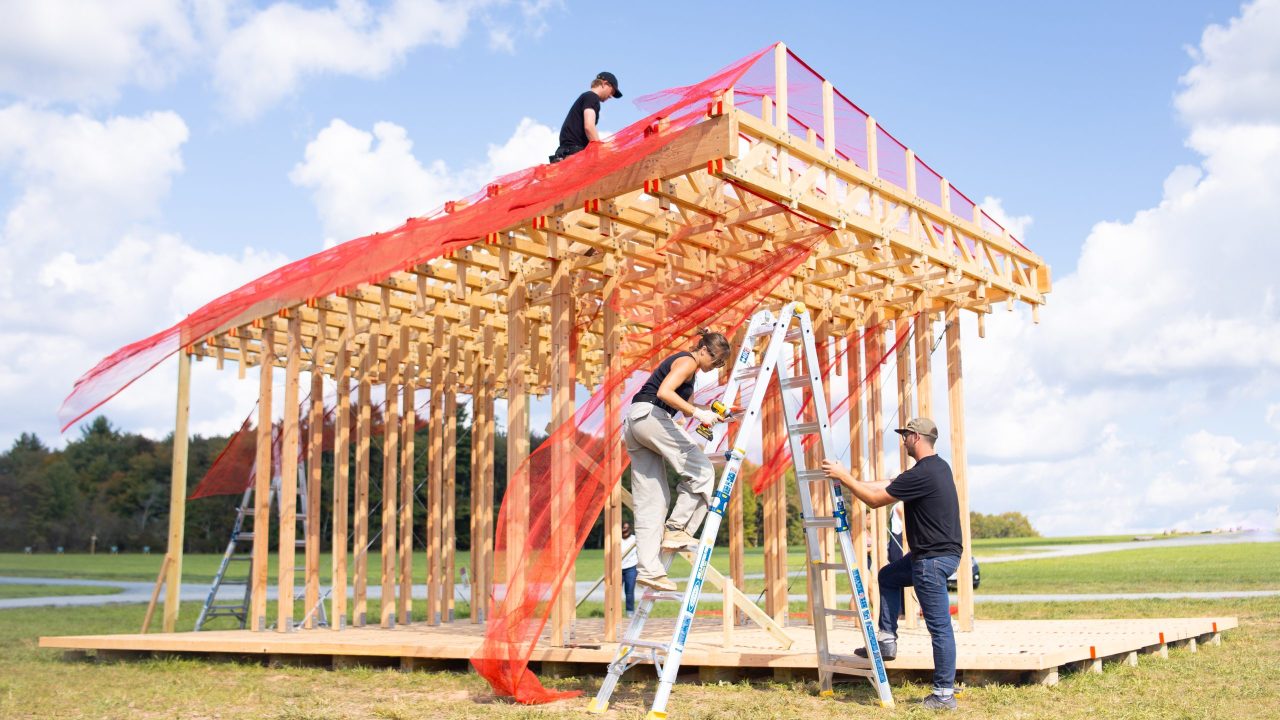
Two Architecture professors are experimenting with a new technique that could make construction documents a thing of the past.
Both Assistant Professors in the School of Architecture, Planning and Landscape Architecture (APLA), Cait McCarthy and Jordan Young are the co-founders of the award-winning interdisciplinary design practice office office, which tests materials and processes across multiple scales and forms.
“As a practice, we’ve always had a deep interest in process and materiality, rethinking our own methods to work more intelligently,” Young said, explaining that they often operate out of budget constraints and work to reduce waste.
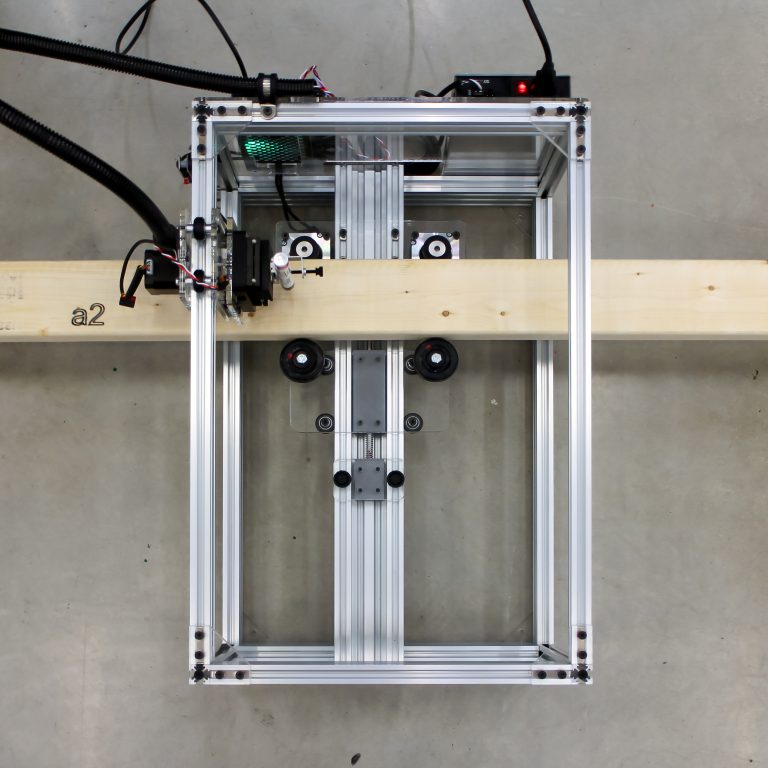
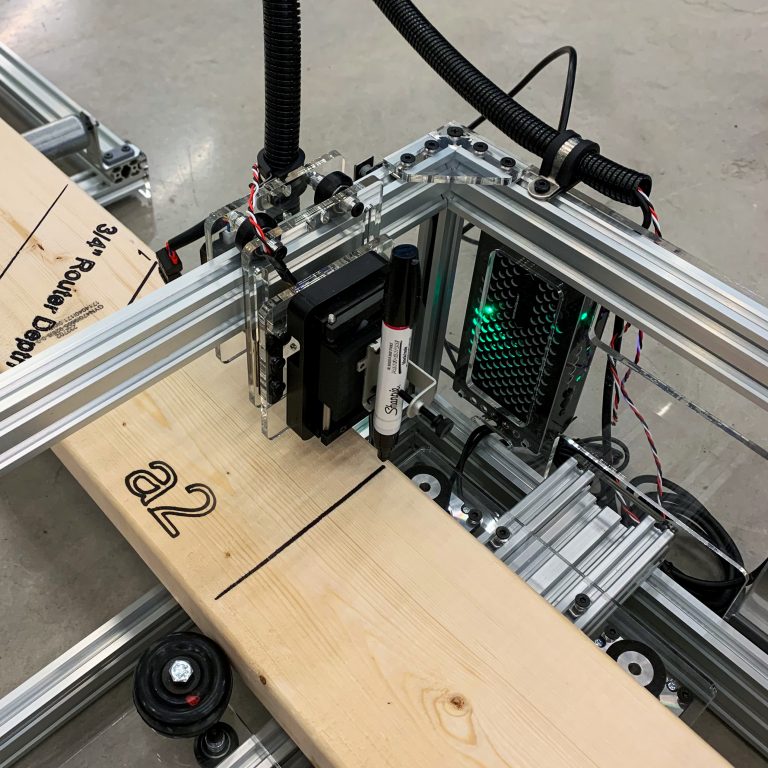
The pair have recently been experimenting with an annotation system known as Direct Annotative Construction that focuses on the relationship between drawing and fabrication. Following detailed Rhino models, a custom marking robot, Scribe 2.0, inscribes fabrication and assembly information—like cut angles, drill points, alignments and part numbers—directly into the timber elements in red ink. Then, onsite crews can follow the assembly drawings and notes on the individual pieces, reducing the need for complex construction documents.
“It’s a way of having something highly precise that can be customized, while being relatively low-cost,” Young said.
McCarthy and Young applied the method for two recent projects for BuildFest, a workshop run by the Bethel Woods Center for the Arts in which university faculty design and construct large-scale art installation on the grounds of the 1969 Woodstock festival.
In 2024, the pair took a group of Auburn students to New York to build Curtain Call. Using Human-Robot Collaborative Construction (HRCC), the group created a pavilion that references the tectonics of the Woodstock ‘69 stage. Built in just four days, the flexible pavilion accommodates a wide range of activities with an open-air deck, asymmetrical columns and red mesh-wrapped roof.
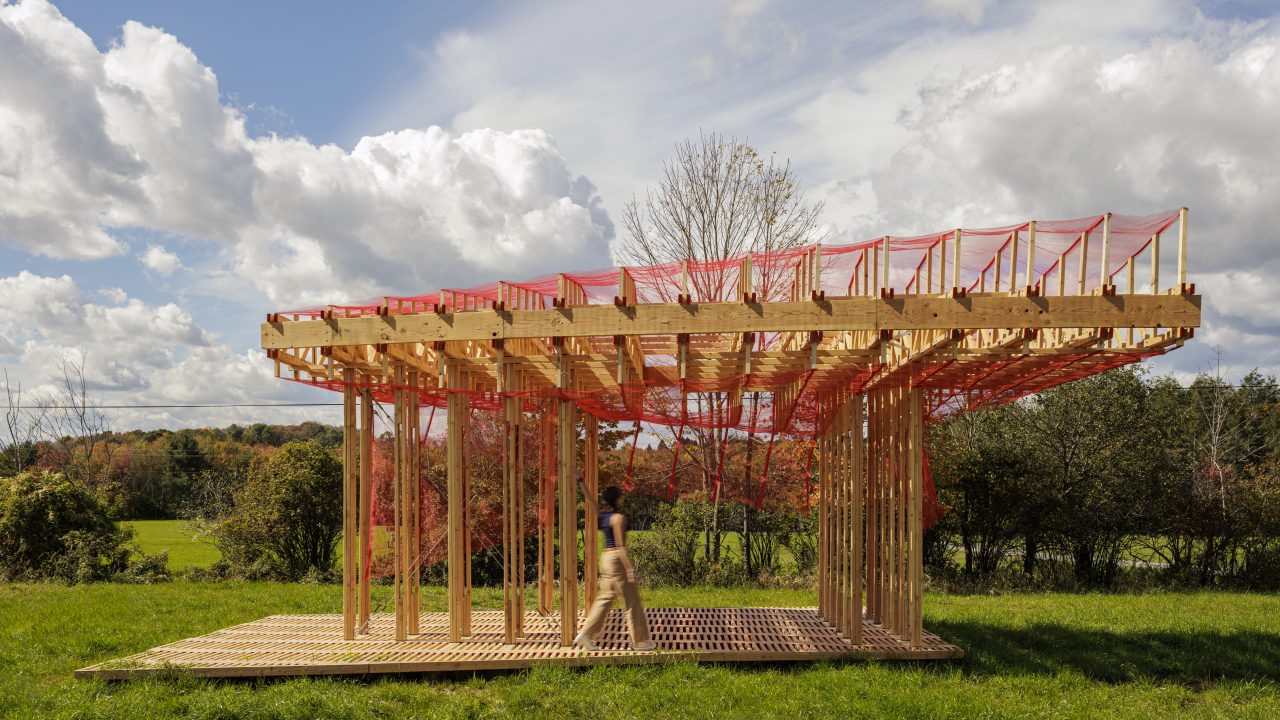
“This technique allows for people who have very little construction experience to take part in the fabrication process,” McCarthy said. “There was a group of students with varying degrees of construction experience, who had never really seen the project before, and they were able to help us assemble this very complex, non-standard structure.”
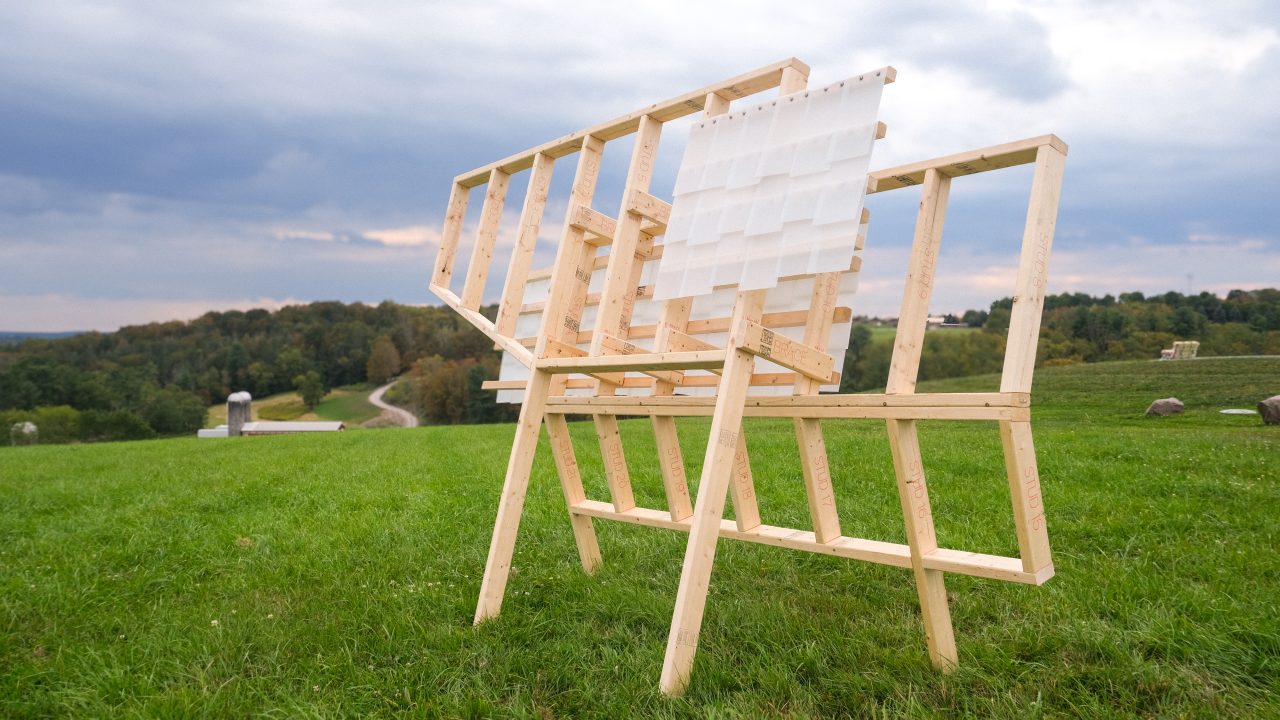
This fall, McCarthy and Young kicked off a three-part installation series that explores participatory construction with student collaborators in a project called Annotative Assembly 01. Constructed in less than two hours, the installation is composed of pre-marked dimensional lumber and shingles sourced from fluorescent light lenses and serves as an exploration for rethinking wood construction.
In May, office office collaborated with Rarify to design an exhibition framework for the International Contemporary Furniture Fair in New York City. While not employing the marking system, the digitally fabricated project Form & Forest served as a display that could be quickly assembled and disassembled, helping to reduce the waste of tradeshows. The armature held an array of furniture from mid-20th century works by Hans Wegner and Finn Juhl to contemporary pieces by Kengo Kuma and Kenya Hara.
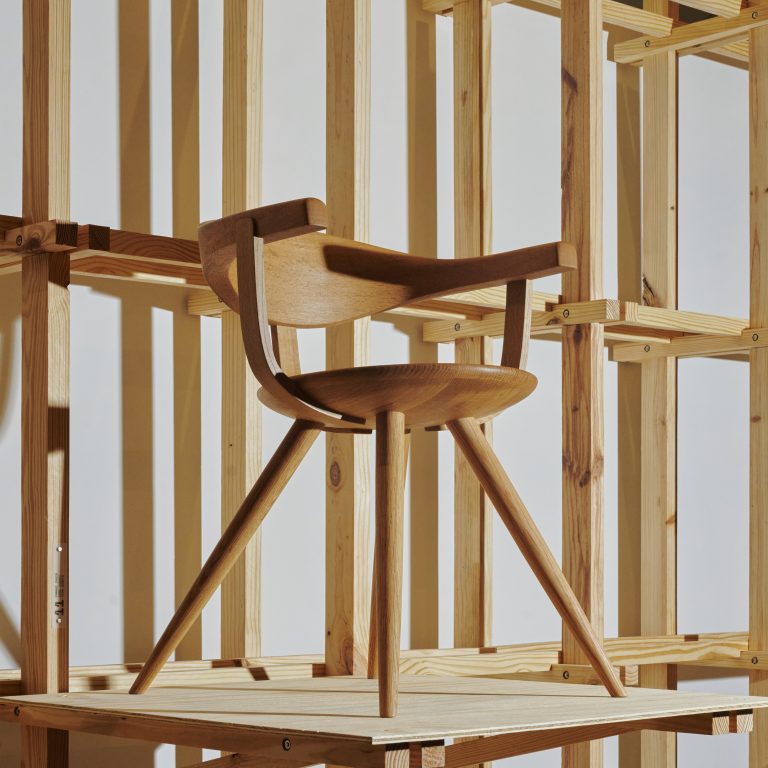
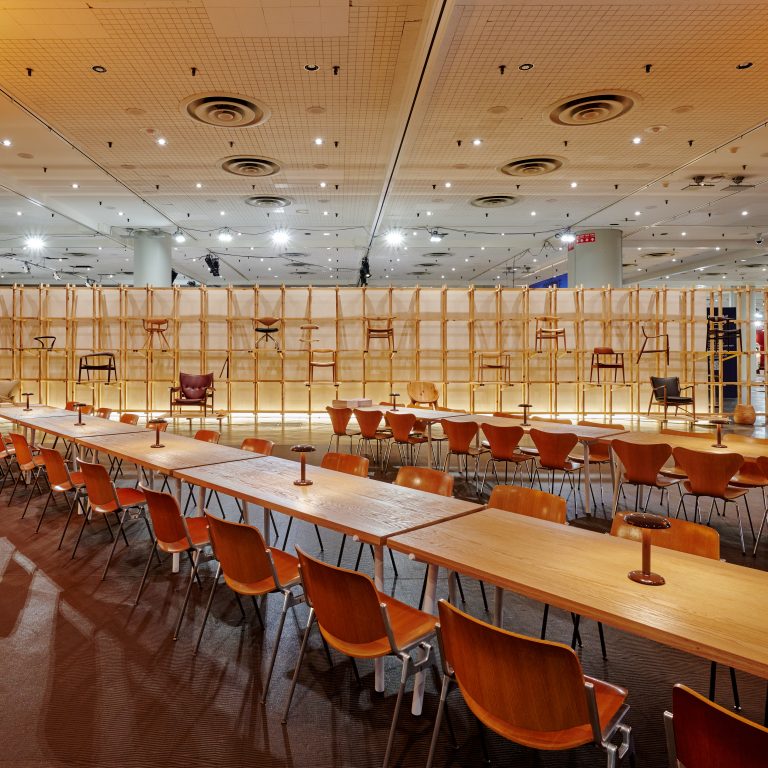
Students across the Architecture, Environmental Design, Industrial Design and Graphic Design programs helped develop Form & Forest, providing input on the exhibition, fabrication and potential future uses of the structure.
“Beyond the future exhibition, we wanted to make the project itself an educational experience that you might not get in the classroom—building at full scale and working with a client,” Young said.
Related people:
Cait McCarthy,
Jordan Young,
Kate Mazade